"Please"
Vignette: "Please," written August 5, 2026.
Ellis called me on a Tuesday afternoon. This was unusual — inasmuch as most things around Ellis are already unusual — because in twenty-two years he had never once called me at an hour when a person might reasonably be expected to answer. He calls at three in the morning, or during a funeral, or in the eleven minutes I have set aside to eat lunch standing up. I have always considered this a trait of his personality instead of assuming rudeness, since time doesn't have a tendency to work normally around him the way it does for the rest of us, and I don't have the impression that he generally needs to consider other people's schedules.
So, when he called me at ten past two on a Tuesday, I already knew something was odd even before picking up and having to repeat his name into the silence twice before he finally answered.
"Could you come," he said.
He did not say it like a question. I held the phone to my ear for a moment longer than I needed to. In twenty-two years he had never asked me for anything: he had never asked for a ride, help with the shopping, or a forty-dollar loan. He had never participated in the ordinary economy of favours between friends to such a degree that I realised, phone against my ear in that moment, that I had stopped expecting him to do so without consciously deciding it.
"Yeah," I said, quickly. "Yeah, of course. Half an hour."
His building is ordinary. I have thought about that fact often over the years. When I first met him, I found that I could not hold his address in my head for more than a day or so at a time. I would write it down and lose the paper, even when I made sure to leave the paper somewhere so it wouldn't be lost. Or, I would remember the flat number but forget the street. And then at some point after about a year this simply stopped happening and I could find his place whenever I wanted. I understood, somehow, that he had altered this intentionally; it was something he had done rather than being something that had worn off, or something I'd gotten used to. It is the only gift he has ever given me.
Ellis' building is made of brick, has three storeys, features a buzzer panel with faded nameplates under milky plastic, and has a stairwell that smells of unfamiliar, but welcomed, cooking. The door was on the latch when I got there. I touched the handle, turning it quietly and sticking my head in. Even invited, I couldn't shake the feeling of trespassing.
"Ellis?"
"In here."
The flat was the same as it always had been on my previous visits. It looked like a place someone had furnished once and then stopped thinking about. It contained a good chair, a poor lamp, and a bookcase with books arranged by no clear system. He claims the order is chronological, though he has never explained the timeline the system is predicated on. I walked into the kitchen, noticing without surprise that the kettle was cold. The only light I could make out was coming from the bathroom at the end of the hallway. The door was open. I paused outside for a moment to set my expression before entering the way one might at a hospital — gathering my face into something I'd want to be met with.
Ellis was in the bath.
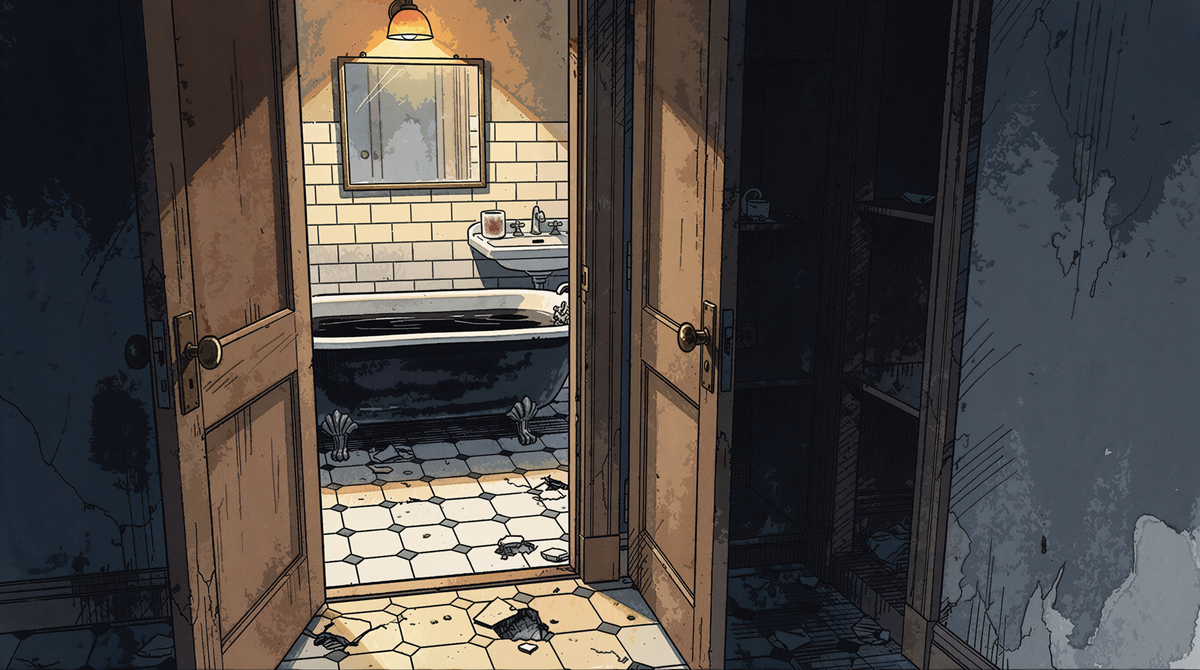
The water reached just below his collarbones. His arms rested along the edges of the tub on both sides, in a stiff position as though he was being propped up instead of relaxing. His knees were up out of the water, and his head was leaned back against the rim of the tub so that his throat was long, and exposed. He did not look over at me when I entered.
Then I noticed the mirror.
The glass was completely clear and dry as a clean plate. There was no steam in the room, and the air was not warm or humid even though the bathroom's small, high window was closed. I put my hand on the surface of the water without asking. It was cold, still, and level. The feeling passed over me like I was in a church and touching something I wasn't supposed to.
I cleared my throat and drew my hand back, wiping it on my trousers. "How long have you been in there?"
"I don't know," he said, and then, after a while: "That's true, by the way. I'm not being... I don't know. I wasn't keeping track." He shrugged, half-hearted, the movement barely disturbing the water surface.
I said something like right, or okay, because I could not think of anything else to say. I went to the kitchen and turned on the kettle. My mother always did that when faced with rooms where bad news was waiting to be delivered, and it seems that I had picked up the same habit. At any rate, I had a hunch that having a cup of tea to hold for the next little while was better than having nothing to hold.
When I returned with two mugs, he had turned his head. He watched me place his mug on the edge of the sink where he could reach it, though we both knew he would not.
"You didn't have to come."
"You asked me to come," I said, sipping the too-hot Earl Grey from a stale teabag.
"I know. I've been thinking about that. I don't think I've done that before."
"You haven't," I said, aware of the unspoken implication that he meant "with anyone." I sat on the floor with my back against the linen cupboard door. This placed me lower than him and slightly behind him. I did this on purpose. I have been the person in the bath in a similar state twice in my life, and the worst part both times was being regarded like I was pitiable.
Neither of us spoke for a while. I drank my tea and listened to the ratty exhaust fan and the irregular noises from the pipes in the wall. There were no other sounds. Rooms that Ellis is in tend to be quieter than rooms he is not in, but the quiet is not peaceful.
"Someone asked me for something," he said.
"Okay."
"On Thursday. I think it was Thursday." He moved one large, gentle hand slightly, and the water shifted around his wrist. "A car park. One of the big ones at a hospital, built bigger than the hospital building itself so it's impossible to keep track of what level you're on. He was sitting in his car and he had not started it yet. I don't know how long he had been sitting there. It's not..." He trailed off. "You don't get the before — when someone asks, I mean. You only get the moment they actually manage to reach out."
"What did he want?" I replied, hair on the back of my neck prickling up at this small insight into what it was to be Ellis in the moments outside of moments like this.
"He wanted his brother to answer the phone."
I waited for him to continue, but he had finished speaking. After a moment, he shrugged again.
"That was all of it. He had called him twice that afternoon and got the answering machine both times. He wanted, very much, for the third call to be answered. He didn't know he was asking me. No one knows they are asking me. That is my purpose. When there is no one else to ask, people say please to the room, and I am the room."
"And did he? Answer, I mean. The brother."
"Yes."
"What did they say to each other?"
"I do not know," Ellis replied. "I don't get that part. I never do. I see the attempt to reach out and then nothing else. I have been fine with that for a long time. It's what I'm for. I am not telling you this because I have stopped being fine with that. That is not the issue."
The tea was becoming cold in my hands. I drank some of it anyway.
"Then what is the issue?"
"I did not have enough in me," he said. "It has a cost — answering — and I did not have it in me. I knew that before I acted, and I did it anyway."
I have known Ellis for twenty-two years. Across that time, I have understood about a third — if I'm being generous to my own intellect — of what he is. But I have never seen him look the way he looked right then. He did not look tragic or haunted. He looked spent. He looked like a person who has given blood too many times in a year but continues to be cheerful about the offering. He had a grey colour around his mouth that was not sadness. It was the look of a body trying to perform an equation it cannot balance out.
I looked away at the tap for a second. As I did, I found that I could not remember his face.
A face I've regularly, if patchily, seen since I was nineteen. I looked at the chrome of the tap and tried to visualise him, but there was no shape to the memory. I only knew he was there, the way you know a word will feel in your mouth without having to say it. I looked back at him quickly and he was still there, looking as he always had. I decided not to mention this. I have wondered since then if that was cowardice or kindness. I still do not know.
"He would have been all right," I offered gently. "The man. Even if you hadn't helped. The brother might have rung back on his own, or he would have —"
"Don't."
It wasn't sharp. That was almost worse. Ellis just sounded tired. He sounded like someone telling a child to stop touching something hot after the hundredth warning that it would burn them. My ears warmed and I felt embarrassed with no real reason for it.
"I wasn't —"
"You were going to give me advice," he said. He had not lifted his head. "You were going to say it was not necessary to push myself, when you don't have the barest level of context for what is and isn't necessary. I am not angry. If I were in your position, I would probably do the same thing. But I need you to stop. It does not help, and then I'll have to manage your feelings when you feel unhelpful. I can't do that today."
"All right."
"I do not know if it was worth it," he finally said, quietly, almost to himself. "It isn't like I have a scale for this kind of thing. I'm not complaining — this is just something without a size that can be measured. The man wanted his brother to answer the phone and his brother answered the phone. I do not know what that achieved for him and I never will. The cost was the cost. Both of those things are true, and they are simultaneously related and irrelevant to any of it."
The pipes made a ticking sound. Someone upstairs walked across a room.
"Is there a way to not do it —" I started to ask. I stopped and then started again hesitantly. "Is there a way to not do it when you don't have enough?"
"Yes."
"I see."
"I could have chosen not to," he said. "Nothing forced me. He was not special. He was not even a particularly good man as far as I could tell. He was a stranger in a car park who had run out of ideas. There are eleven, twelve people like him an hour, always pulling at my awareness, all day long, forever. I do not do it for all of them. I have never been able to explain how I choose. I reached him and I had nothing left, but I did it anyway."
"Why?"
"That is the question, isn't it?" he said. For the first time, he sounded more like himself. "I have been lying here since Thursday thinking about that. I think I did it because if I had let that one go after answering, I would have had to find out if I could keep letting them go. And I think I would rather be in this state than understand that capacity about myself."
I put the mug down on the tile beside me. It made a small, flat noise. I sat with empty hands and knew I had nothing to offer. In all the time I'd known Ellis, this was the most open vulnerability he had ever given me, and I knew that my collection of standard human comforts was of no use in an interaction like this. All of those were meant for mortal people's problems with mortal people's boundaries. Invoking any of them now would just be an insult in this room. I couldn't tell Ellis that these feelings would pass, because I didn't know if they would. I couldn't give him meaning or purpose because I was staring at a reality I didn't understand the meaning or purpose of, either. I couldn't tell him that he should stop, because I somehow knew he would ignore me even if I did — his entire nature prevented him from stopping. At any given moment, any moment from now, there would be another car park and another person asking the universe for another small mercy.
"So, it will happen again," I said, not asking a question.
"Yes."
"Soon?"
"Probably sooner than soon," he replied, without any emphasis, which was how I knew it was the core of the problem. He sighed once more. "That was why I called you — that was the part I couldn't handle alone, this time." He waved his hand dismissively, somehow managing to do so without displacing much of the water at all. "Not the man. The man is finished with. What I can't handle is that there's no version of this where I get to have a rest and get myself ready again. The next person is already coming. I can feel their need coming at me like how you can feel a train shaking the ground long before you hear it. And yet, I'm still sitting in the bath."
I did not say I was sorry. It would have been true, but useless.
What I eventually said was, "I don't know how to help you."
"I know," he said.
"If it were anyone else, I would know how to handle this. I would take you to a doctor, or call a family member, or make you eat. None of those things work here. I don't have a backup plan."
"I know," he repeated. Then he said, "Christopher."
"What?"
"I did not call you because I expected you to have a solution."
I sat there while the fan continued its slow, unsteady rotation and the mirror stayed clear. I thought about how he has responded to some enormous and unguessably large number of people who reached out for help during the worst moments of their lives and there is no system that works for him in the other direction. No one listens to him in the same way; his requests for help do not go anywhere. One Tuesday afternoon at ten past two, he had used up his resources. He did the only thing he could think to do. He called a man he'd known since that man was nineteen and asked him to come over. I found I didn't know how to feel about that.
"The water is freezing," I said at last.
"It is."
"You're not going to do anything about that, are you?"
"No."
I stood up from the floor. My knees were sore and complained about the movement but I ignored their protest. I leaned over the end of the bathtub and turned on the hot water tap.
He did not stop me. He did not move or tell me to stop. He let the water run. It ran cold for a few seconds the way these old taps always seem to and then it warmed up. The hot water came up out of a hot water tank in a cabinet somewhere on the other side of the wall; an ordinary piece of equipment installed by an ordinary person for an ordinary task. The warmer water spread through the bath and I put my hand in near the tap so it wouldn't scald Ellis. In my peripheral vision, I watched him as he let this happen.
After about a minute, his shoulders relaxed slightly. It was a small, but visible, change.
Steam started to come up off the surface in an unhurried, predictable, and entirely unmiraculous way. I looked up and noticed that the bathroom mirror had become foggy at the edges and then slowly across its whole, smooth surface. I couldn't see our reflections in it after a moment.
"That's better," he said, quietly. It was better in some ways. It was the same in others.
I sat back down on the floor.
I stayed until the water needed doing again, and then I did it again.

Comments: